Journaling Shouldn't Start With a Blank Page
Conviction gives you guided prompts personalized to your emotional state, therapy type, and journaling history. No blank page. No pressure. Just the right question at the right time.
Download FreeThe Blank Page Problem
Most journal prompts online are generic and one-size-fits-all. They're written for everyone, which means they're written for no one. You scroll through lists of '365 Journal Prompts' and nothing connects to what you're actually going through.
You're told to 'write about what you're grateful for' when you're in crisis. The prompt doesn't know you just had a panic attack, or that you've been avoiding a conversation for three weeks, or that gratitude isn't what you need right now.
The blank page itself creates performance anxiety. You open your journal, stare at the cursor, and close the app. It's not that you don't want to reflect. It's that you don't know where to start. The emptiness feels like a test you're failing.
Most guided journals are just prompt lists that never adapt. Day 1: Write about your childhood. Day 2: Describe your ideal morning. They don't learn what you've already explored, what you're avoiding, or what needs attention today.
What if your journal knew what to ask?
Guided, Not Scripted
Prompts that adapt to you — not the other way around.
Conviction's guided journaling learns your patterns, respects your therapy type, and asks the question you didn't know you needed. Whether you're processing a therapy session, managing anxiety, or journaling for the first time, the prompts meet you where you are.
How Guided Journaling Works
Choose your mode
Free writing, guided prompts, voice entry, or structured exercises like CBT thought records.
Answer one question
The AI selects a prompt based on your recent entries, emotional state, and journaling history. No two sessions are alike.
Go as deep as you want
One sentence is enough. Three paragraphs is fine too. The prompt opens the door — you decide how far to walk.
See your patterns over time
Guided entries build a map of your emotional landscape. Conviction tracks themes, not streaks.
Built for Real Journaling
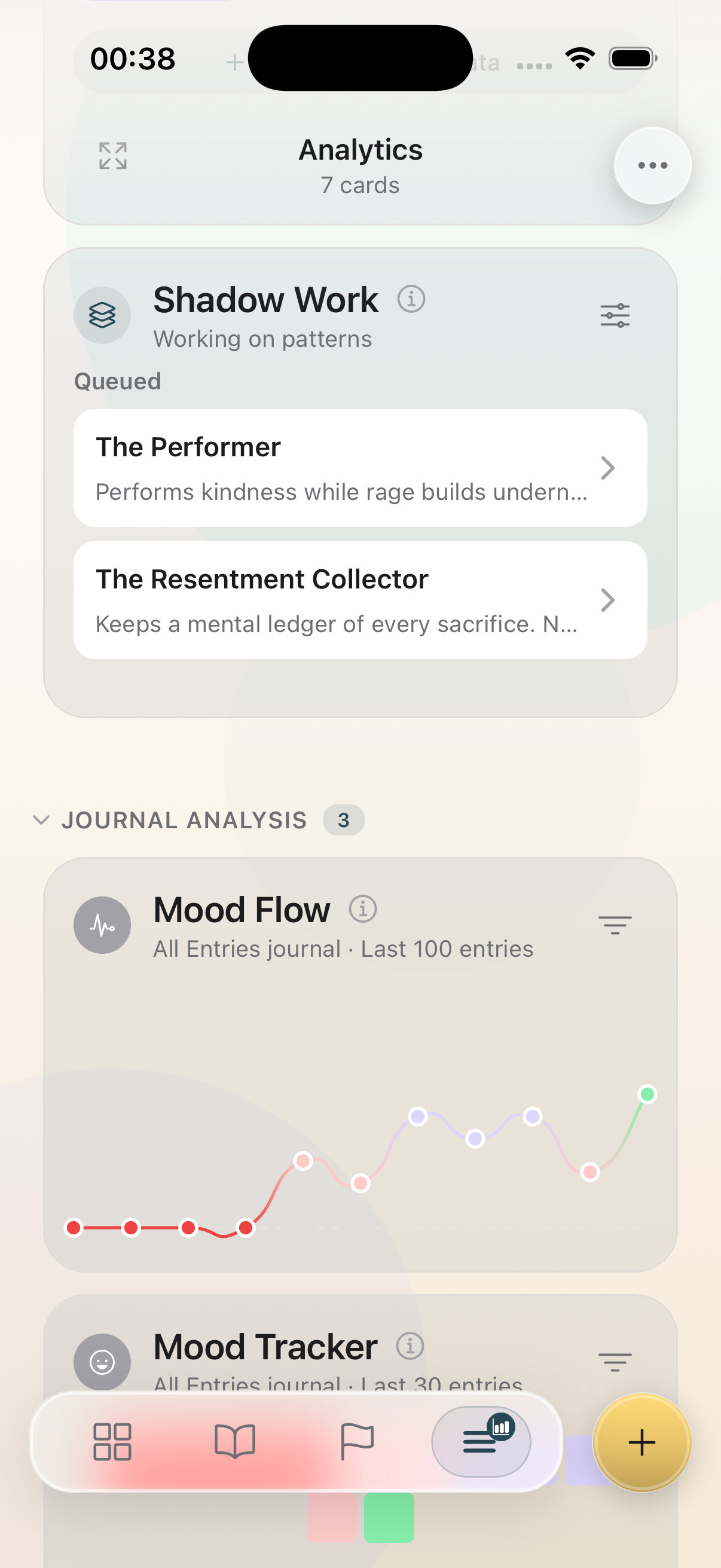

Face the patterns you've been avoiding.
Guided reflections grounded in psychological principles, not 400 generic prompts from a PDF. Conviction finds recurring shadow patterns across your entries and turns them into goals you can track. Not pop psychology. Structured self-confrontation.
- Pattern detected Conviction reads across your full history to surface the loops and patterns you missed in the moment.
- Reflect deeper Guided prompts built from your actual entries. Not generic questions. Real patterns turned into focused self-inquiry.
- Track your progress Patterns become trackable goals. See which loops you are breaking and which ones still run beneath the surface.
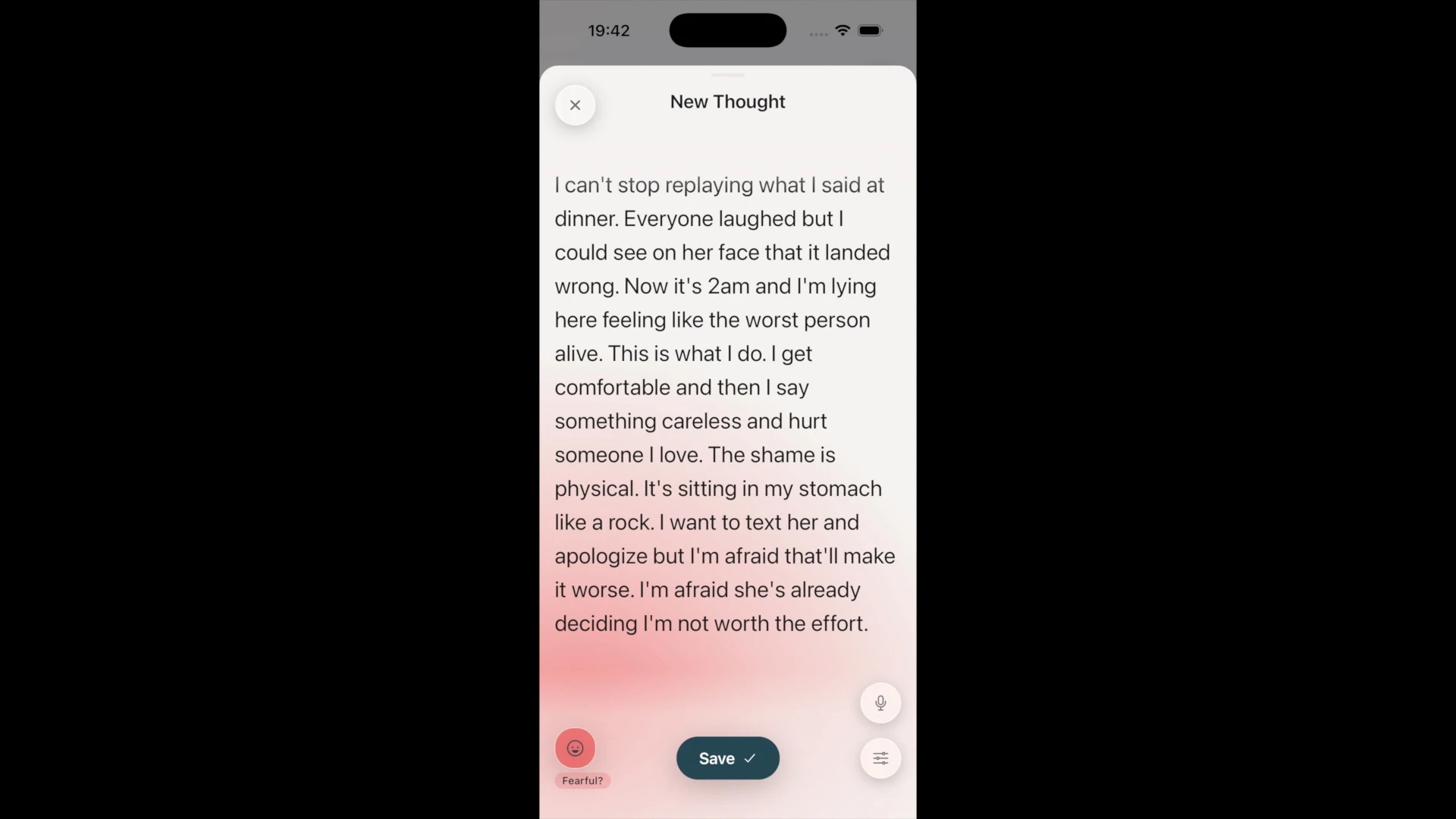
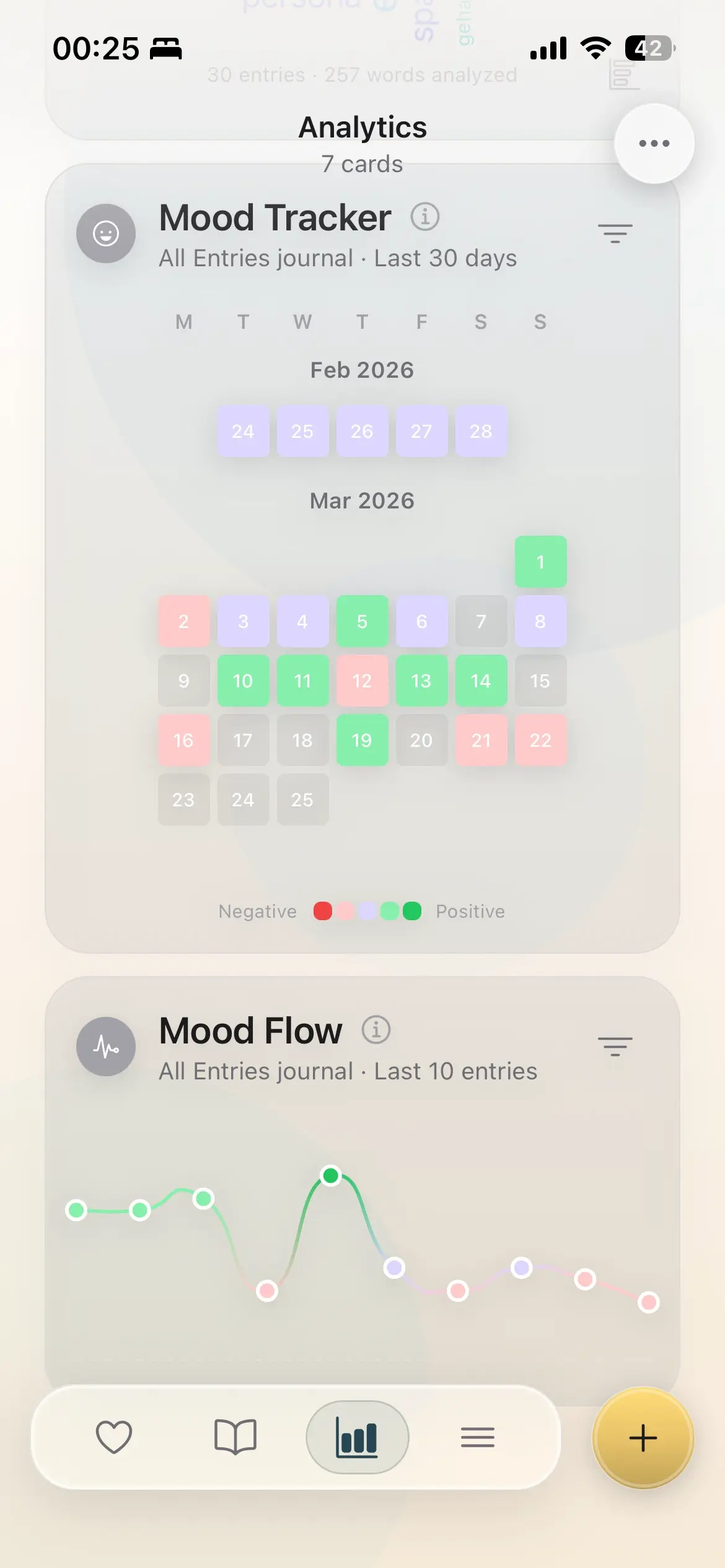
Beyond "fine." Name what you actually feel.
Every entry gets analyzed across 27 emotion categories. Not just positive or negative, but specific: guilt vs. shame, nostalgia vs. grief. Mood Flow shows how your emotions shift over time.
- 27 emotions Every entry is read for specific emotional categories. Not generic mood sliders.
- Mood Flow See how your emotional patterns shift week over week. Spot what triggers what.
- Your patterns Conviction connects entries over months. What keeps showing up becomes visible.
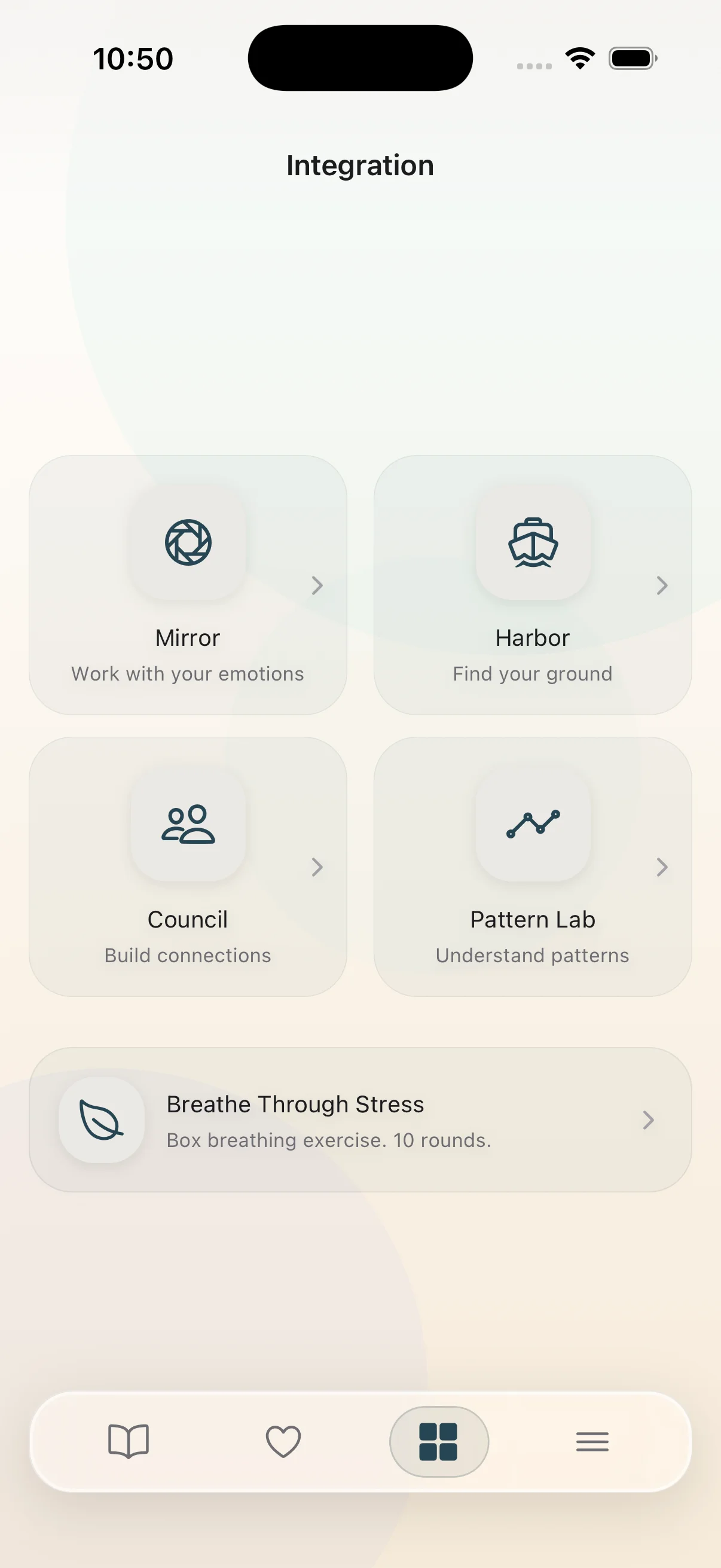
Tools inspired by what works in therapy. For your own practice.
Four self-guided toolkits grounded in evidence-based approaches: The Mirror (thought reframing), Safe Harbor (somatic grounding), Pattern Lab (chain analysis), The Council (assertiveness and validation). Use them between sessions. Or when you want to go deeper on your own.
- Four toolkits The Mirror, Safe Harbor, Pattern Lab, and The Council. Pick the one that fits what surfaced.
- Safe Harbor Somatic grounding exercises for when the insight hits harder than expected. Paced breathing, body scan, sensory orienting.
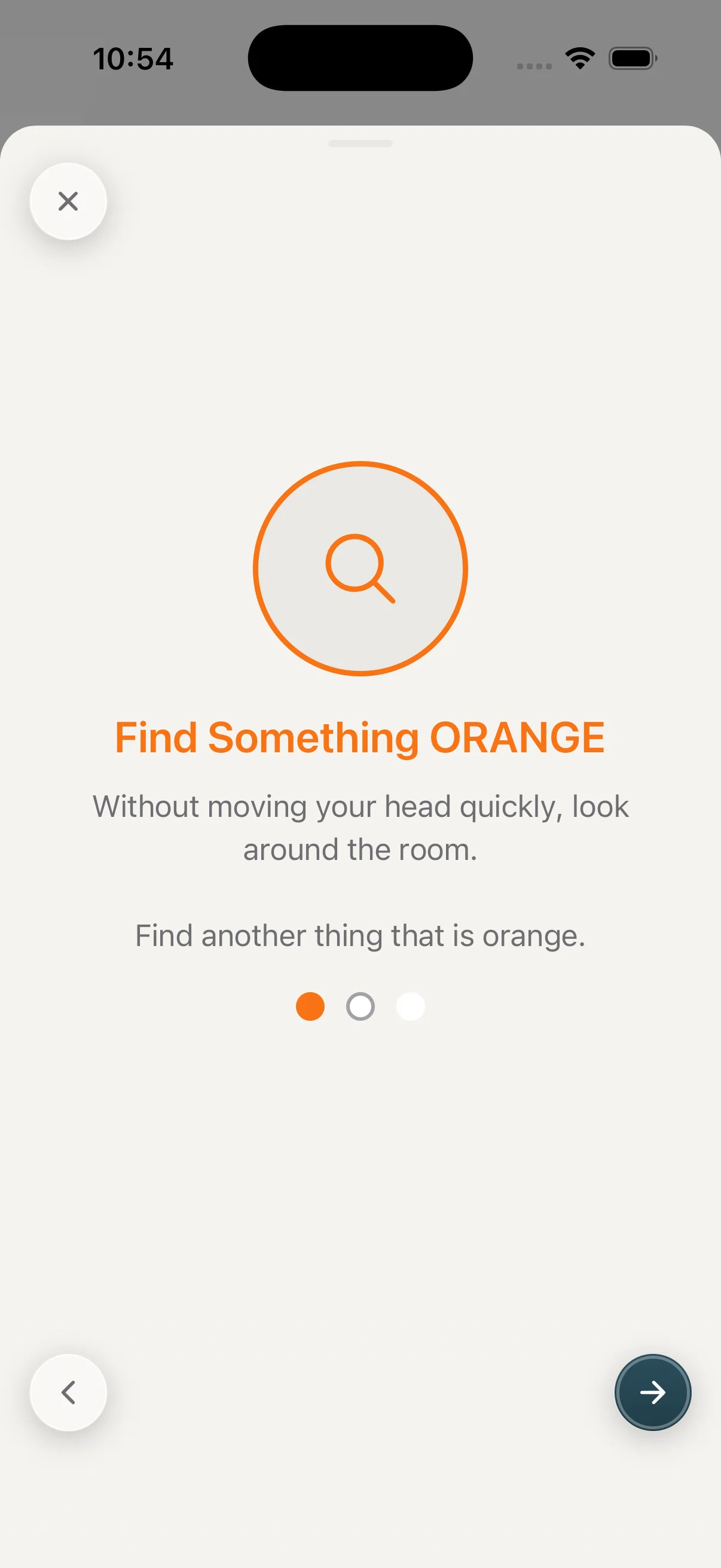
- Sensory orienting Find something orange. Find something stable. Find something pleasant. Ground yourself in the room you're in.
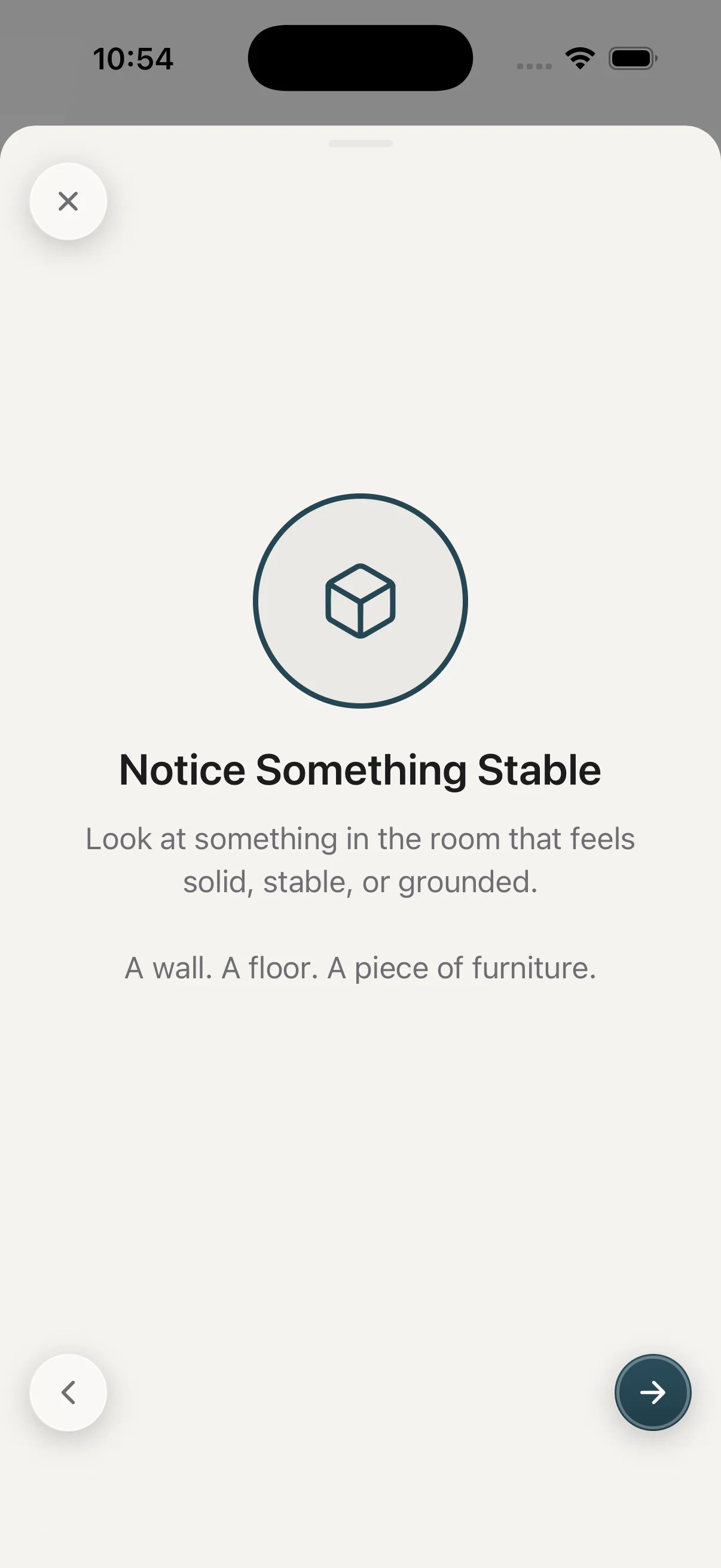
- Notice what's solid A wall. A floor. A piece of furniture. Stability is already around you.
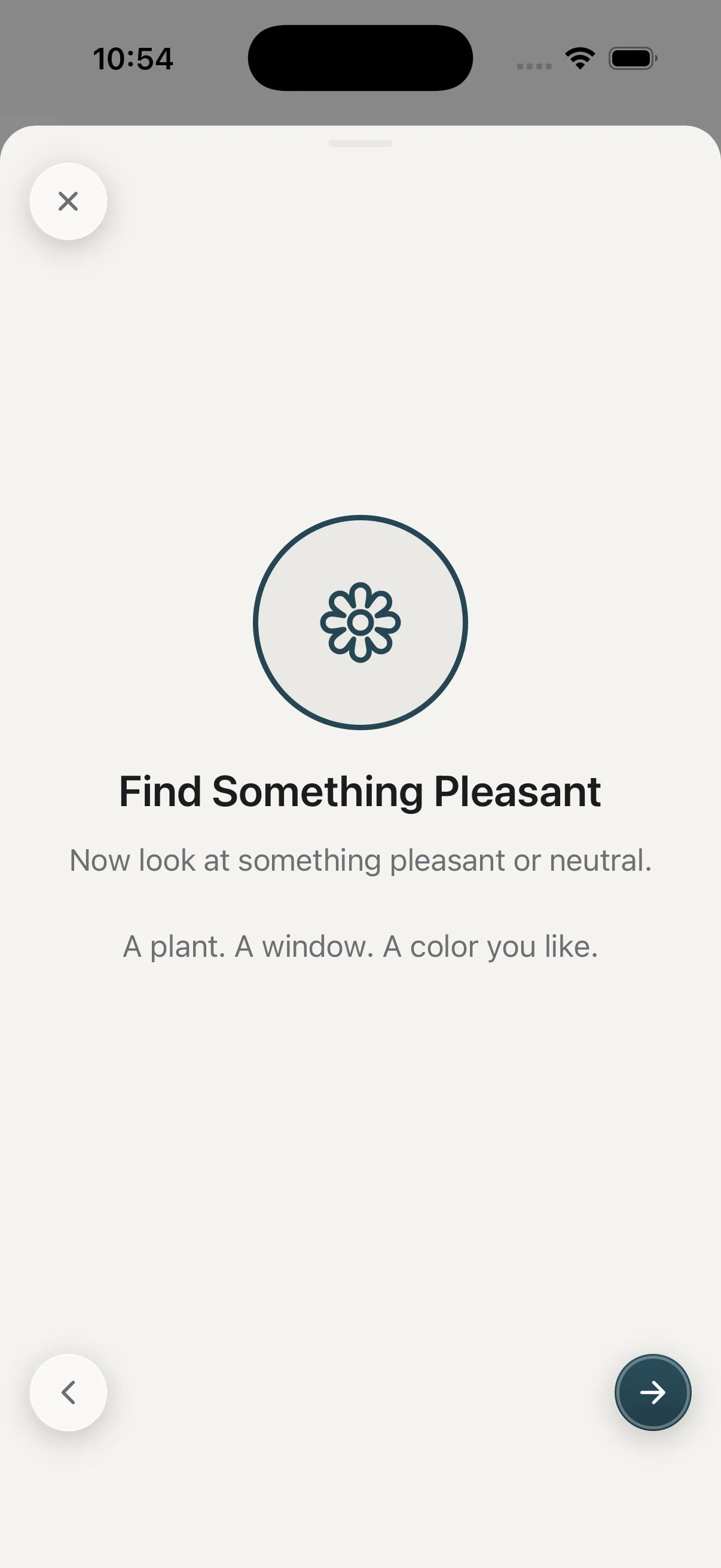
- Find something pleasant A plant. A window. A color you like. Simple tools that interrupt the nervous system spiral.
And so much more.
Therapy-Aligned Prompts
CBT thought records, IFS parts dialogue, somatic check-ins, DBT diary cards. Prompts organized by the therapy you're actually doing.
AI-Personalized Questions
The AI reads your recent entries and emotional patterns to suggest the prompt most likely to unlock something real. All processing happens on your device.
Voice-First Option
Don't want to type? Speak your entry aloud. On-device Whisper transcription turns your voice into structured text. Stream Mode for when thoughts move faster than fingers.
27 Emotion Classification
GoEmotions-powered analysis identifies 27 distinct emotions in your entries — far beyond 'happy' and 'sad.' See what you're actually feeling, not what you think you should feel.
Momentum System
No streaks. No guilt. Conviction tracks patterns across entries, not consecutive days. Missing a day doesn't reset your progress.
On-Device Privacy
Your journal entries never leave your phone. No cloud sync of content. No third-party AI. SQLCipher encryption protects everything locally.
Flexible Entry Types
Guided prompts, free writing, voice notes, structured exercises. Switch between modes within the same session. Your journal adapts to your energy level.
Start free. Upgrade when ready.
Complementary choices for different needs
Best for acute needs, diagnosis, and deep clinical work
Great for accountability and structured goal-setting
Daily self-reflection practice that supports both
- Talk or type. Your voice becomes entries on your device.
- 27-emotion tracking with Mood Flow visualization.
- Safe Harbor: guided somatic grounding exercises.
- Structured CBT and DBT journaling frameworks.
- Momentum System that never resets your progress.
- Encrypted on-device storage. Everything stays on your phone.
Pro
- All from free tier without limits
- Automatic mood detection of your thoughts
- Shadow pattern detection with goal tracking (Shadow Work)
- Personalized shadow pattern journaling prompts based on your pattern
- One-click in-depth analysis of your entries to help you spot recurring themes (Magic Mirror)
- Native Apple integration for iCloud backup and Apple Health
No credit card to start. Upgrade anytime.
Frequently Asked Questions
What is guided journaling?
Guided journaling uses prompts or questions to direct your writing instead of starting from a blank page. Rather than figuring out what to write about, you respond to a specific question designed to help you explore your thoughts, emotions, or patterns. Conviction takes this further by personalizing prompts based on your emotional state and journaling history.
Is guided journaling better than free writing?
Neither is better — they serve different purposes. Free writing is great when you know what you need to process. Guided journaling helps when you're stuck, overwhelmed, or want structured reflection. Conviction supports both modes so you can switch based on what you need in the moment.
What therapy types do the guided prompts cover?
CBT thought records, IFS parts dialogue, DBT diary cards, ACT values exercises, somatic body scans, and general emotional processing. Each prompt type is designed around the structure of its therapy modality, so your entries align with the work you're doing in sessions.
Do I need therapy experience to use guided journaling?
No. The prompts work for complete beginners and experienced journalers alike. You don't need to know what CBT or IFS means to benefit from the prompts. The questions are written in plain language and guide you step by step through the reflection process.
How does the AI choose my prompts?
The AI analyzes themes and emotions in your recent entries to suggest prompts that are relevant to what you're currently processing. If you've been writing about workplace stress, it won't suggest a gratitude prompt. All analysis happens on your device — your entries are never sent to a server.
Is my journal data private?
Yes. All AI processing happens on your device. Your journal entries are encrypted with SQLCipher and never leave your phone. There's no cloud sync of content, no third-party AI, and no way for anyone — including us — to read your entries.
Can I switch between guided and free writing?
Yes. Every session lets you choose your mode. Start with a guided prompt and switch to free writing mid-entry, or go the other way. You can also use voice input, structured exercises, or stream-of-consciousness mode. The format adapts to your energy level.
Does guided journaling have to be daily?
No. Conviction uses a Momentum system instead of streaks. Your progress builds gradually and cools slowly when you're away — it never resets to zero. Journal three times a week, once a week, or whenever something comes up. There's no minimum frequency and no guilt mechanics.
Prompts that are a next step, not a 365-day list
Stuck, anxious, or starting. These are the journaling jobs behind guided prompts.
Your Journal Should Ask Better Questions
Guided prompts by therapy type. AI that adapts to your patterns. Voice input when typing feels heavy. Everything stays on your device.
Download FreeNo credit card required. No streak to break.